King County Voters:
Vote APPROVE on King County Prop 1,
Yes for Behavioral Health
This transformative levy creates a place for people to go and receive life-saving care during a crisis, meets the needs of our growing community, and supports a path to recovery.
Vote by April 25
What is the Crisis Care Centers Levy?
WHAT KC PROP 1 FUNDS
Establish five Crisis Care Centers, including a center dedicated to serving youth, distributed across our county with walk-in access and the potential for short-term stays to help people stabilize.
Maintain and restore residential treatment beds, which have steadily declined over the years as the demand for care increases.
Grow the behavioral health workforce with career pathways and equitable wages through apprenticeship programming and access to higher education, credentialing, training, and wrap-around supports.
Provide immediate services to meet our immediate needs using initial funds to create mobile or site-based crisis behavioral health services that can operate until the first crisis care centers open.
For $121 per year for the average homeowner, we can invest in the behavioral health needs of our community today and begin a path to recovery.
Connecting the behavioral health crisis system to be more effective, more accessible, and more equitable so every person in King County can thrive. King County is charting a path forward to create a regional network of crisis care centers, preserve and increase residential treatment beds, and invest in a robust behavioral health workforce. Together, these efforts will increase public well-being and safety, and give families, first responders, and crisis response teams better places to take people than jails and emergency rooms.
What is the Crisis Care Centers Levy?
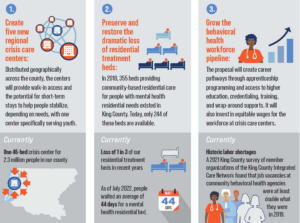
The behavioral health package developed by Executive Constantine with the support of the broad-based behavioral health coalition will do three things:
Create five new regional crisis care centers:
Distributed geographically across the county, the centers will provide walk-in access and the potential for short-term stays to help people stabilize, depending on needs, with one center specifically serving youth.
Preserve and restore the dramatic loss of residential treatment beds:
In 2018, 355 beds providing community-based residential care for people with mental health residential needs existed in King County. Today, only 244 of these beds are available.
Grow the behavioral health workforce pipeline:
The proposal will create career pathways through apprenticeship programming and access to higher education, credentialing, training, and wrap-around supports. It will also invest in equitable wages for the workforce at crisis care centers.
View the complete Crisis Care Centers Levy PDF >>Prop 1 KCCCCL PDF
Dow Constantine, County Executive
Claudia Balducci, County Councilmember
Rod Dembowski, County Councilmember
Reagan Dunn, County Councilmember
Jeanne Kohl-Welles, County Councilmember
Joe McDermott, County Councilmember
Sarah Perry, County Councilmember
Pete von Reichbauer, County Councilmember
Girmay Zahilay, County Councilmember
Mayor Bruce Harrell, City of Seattle
Mayor Angela Birney, City of Redmond
Mayor Nancy Backus, City of Auburn
Mayor Dana Ralph, City of Kent
Mayor Lynne Robinson, City of Bellevue
Mayor Penny Sweet, City of Kirkland
Councilmember Teresa Mosqueda, City of Seattle
Rep. Nicole Macri, D-Seattle
King County Sheriff Patti Cole-Tindall
Alison Eisinger, Executive Director, Seattle/ King County Coalition on Homelessness*
Kelli Nomura, MBA, MHP, CEO, International Community Health Services (ICHS)*
Tom Bolger, Board Chair, Sound Mental Health*
Eddie Pasatiempo, Board Vice-Chair, Sound Mental Health*
Mike Heinisch, Kent Youth & Family Services*
* For identification purposes only.
Problem
Our County is without a walk-in behavioral health urgent care facility leaving many cycling through emergency care, jails, and homelessness.
Treatment beds continue to decline, and people are waiting an average of 44 days for a mental health residential bed as of last year. Behavioral health needs are on the rise while the workforce continues to decrease.
Solution
A regional coalition of emergency responders, behavioral health workers, local governments, businesses, and community leaders came together to propose KC Prop 1 on the April 25th ballot.
Prop 1 invests in a countywide network of five crisis care centers, maintains and restores the number of residential treatment beds, and supports the recruitment and retention of our community behavioral health workforce
in the region.
Share your support of Prop 1, Yes for Behavioral Health
Use your voice and encourage those in your network to vote Yes on Prop 1. Share your personal or professional experiences and what better crisis response means to you. Use these to get your email or social media post started, and be sure to tag us, use the hashtag below, or share with us.
Our community is facing a mental health and addiction crisis, so I am enthusiastically supporting a solution by voting ‘Approve’ on King County’s Prop 1 this April. This levy invests in a county-wide network of 5 crisis centers, increases the number of residential treatment beds, and supports the recruitment and retention of a skilled behavioral health workforce.
@YesKCProp1 / @crisiscxns
#yeskcprop1 #mentalhealthbill
As a mental health advocate, I know firsthand how vital it is to invest in crisis care. That’s why I’m proud to support the upcoming King County Prop 1 – Yes for Behavioral Health. Let’s ensure everyone in our community can access the immediate and skilled care they need during a mental health crisis.
@YesKCProp1 / @crisiscxns
#yeskcprop1 #mentalhealthbill
Businesses, labor, health providers, and community organizations are banding together to support @YesKCProp1. This will make King County safer, help those in a mental health crisis regain control of their lives, and support recruitment and retention of our behavioral health workforce.
@YesKCProp1 / @crisiscxns
#yeskcprop1 #mentalhealthbill
Mental health crises can affect anyone, regardless of income, privilege, or race. That’s why I’m urging everyone to vote YES on Prop 1 and support the King County Crisis Care Centers Levy. Investing in a healthy and humane behavioral health system ensures that everyone in our community can access the care they need when they need it most.
@YesKCProp1 / @crisiscxns
#yeskcprop1 #mentalhealthbill
I’ve (volunteered with Crisis Connections for years OR used Crisis Connections services) and have seen their incredible impact on our community. But we need more resources to make sure everyone in our community can access the immediate care they need during a mental health crisis. That’s why I’m urging everyone to vote YES on Prop 1 and support the King County Crisis Care Centers Levy.
@YesKCProp1 / @crisiscxns
#yeskcprop1 #mentalhealthbill
Help our youth in crisis. April 25th is your chance to vote @YesKCProp1 to establish five crisis care centers, including a center dedicated to serving youth, and offer walk-in crisis support and short-term behavioral health treatment.
@YesKCProp1 / @crisiscxns
#yeskcprop1 #mentalhealthbill
Crisis Intervention and Prevention Calls in King County
Press Release
FOR IMMEDIATE RELEASE – March 22, 2023
Crisis Connections Urges King County Residents to Vote Yes on Prop 1 for Crisis Care Centers
Seattle, WA – Crisis Connections, a non-profit organization providing crisis intervention services for adults, youth, and families across King County and Washington State, is calling on King County voters to vote APPROVE on Prop 1 and support the upcoming King County Crisis Care Centers Levy.
As a key provider helping community members navigate the behavioral health system and ensuring no one faces a crisis alone, Crisis Connections staff and volunteers see firsthand the urgent need to invest in long-neglected mental health and addiction treatment services.
“People throughout the community are struggling more than ever to cope. Since early 2020, Crisis Connections has received a record number of calls from people seeking help for themselves or others,” said Michelle McDaniel, CEO of Crisis Connections. In 2022, Crisis Connections helped more than 230,000 people who identified as King County residents, representing nearly 11% of King County’s population. Nearly two-thirds of callers are BIPOC, and the majority are low-income.
“As the ‘front door’ to the crisis system, Crisis Connections staff can assess a situation and offer critical behavioral health services for a caller – whether it’s a visit from a mobile crisis team, a next day appointment with a clinician in their community, or other resources that are appropriate for the situation,” said McDaniel. “But those resources are either stretched thin or unavailable – and therefore, the crisis deepens. In our community, we could not imagine a situation where immediate and skilled care was unavailable when someone had a physical health crisis. But that happens daily when a person is experiencing a mental health crisis.”
The proposed King County Crisis Care Centers Levy, which will appear on the April 2023 ballot, aims to create a regional network of five walk-in crisis care centers, preserve and increase residential treatment beds, and invest in a robust behavioral health workforce. These efforts will increase public well-being and safety and be a place to go for help other than jails and emergency rooms.
“We can’t find one person who isn’t impacted by behavioral health issues,” McDaniel added. “This is a community-wide challenge that we need to solve together.”
Crisis Connections has provided free and highly skilled crisis intervention services since 1964, intervening during a personal crisis, helping to prevent the next one, and providing support after a crisis. Through the 988 dialing code and the King County crisis line service, Crisis Connections supports community members across King County 24/7/365. In addition, residents can find help through other Crisis Connections helplines, including King County 211, WA Recovery Help Line, WA Teen Link, and WA Warm Line.
“Investing in resources so that people – regardless of income, privilege, or race – can access immediate and compassionate mental healthcare must be a priority. We urge King County voters to support the upcoming levy and help us build a stronger, more resilient community for all,” said McDaniel.
CONTACT
Sergey Smirnov I Senior Director of Advancement
direct mobile 206-436-2978 I ssmirnov@crisisconnections.org